Sunday, 22 May 2011

In search of Ratty...

People-watching
Feeling a bit worse for wear following the college Summer Ball, Michelle and I headed up to Abbotts Hall Farm to take part in Essex Wildlife Trust's Water Vole training course.  This course would enable us to survey areas looking for field signs of water voles and feedback our findings to the Trust for their records.

On the way in to the course we spotted a little sparrow peering out of a nest box.  He was there for quite a while just watching the world go by.  After a morning listening to Darren Tansley, an incredibly articulate and knowledgeable man responsible for the Riversearch programme, telling us about the basic ecology of water voles and showing us pictures of habitats and field signs, we headed off to see for ourselves.  First stop was a hide looking out across a man-made lake on the reserve.  We looked to see if we could see any water voles from this area.  We saw lots of birds including coots, moorhens, little grebes, tufted duck, mute swan and cygnets, pochard and mallard.


The view from the bird hide

Water Vole burrows in the bank
From the hide we were able to see water vole burrows in the bank on the lake.  The holes in the picture show some above where the water line had previously been, and some were below that water line.  They use the ones below the water line to escape from predators.

Water voles are rather unfortunate to have numerous predators who will attack them from the air, the land and the water.  The voles have evolved a range of escape tactics which can often be successful; they also breed very effectively and quickly.  Populations of water voles in Essex, and across the country, have dropped considerably and the biggest culprit is believed to be the mink.  A female mink is small enough to get into the voles' burrows and take any animal living there.

Darren telling us about feeding stations

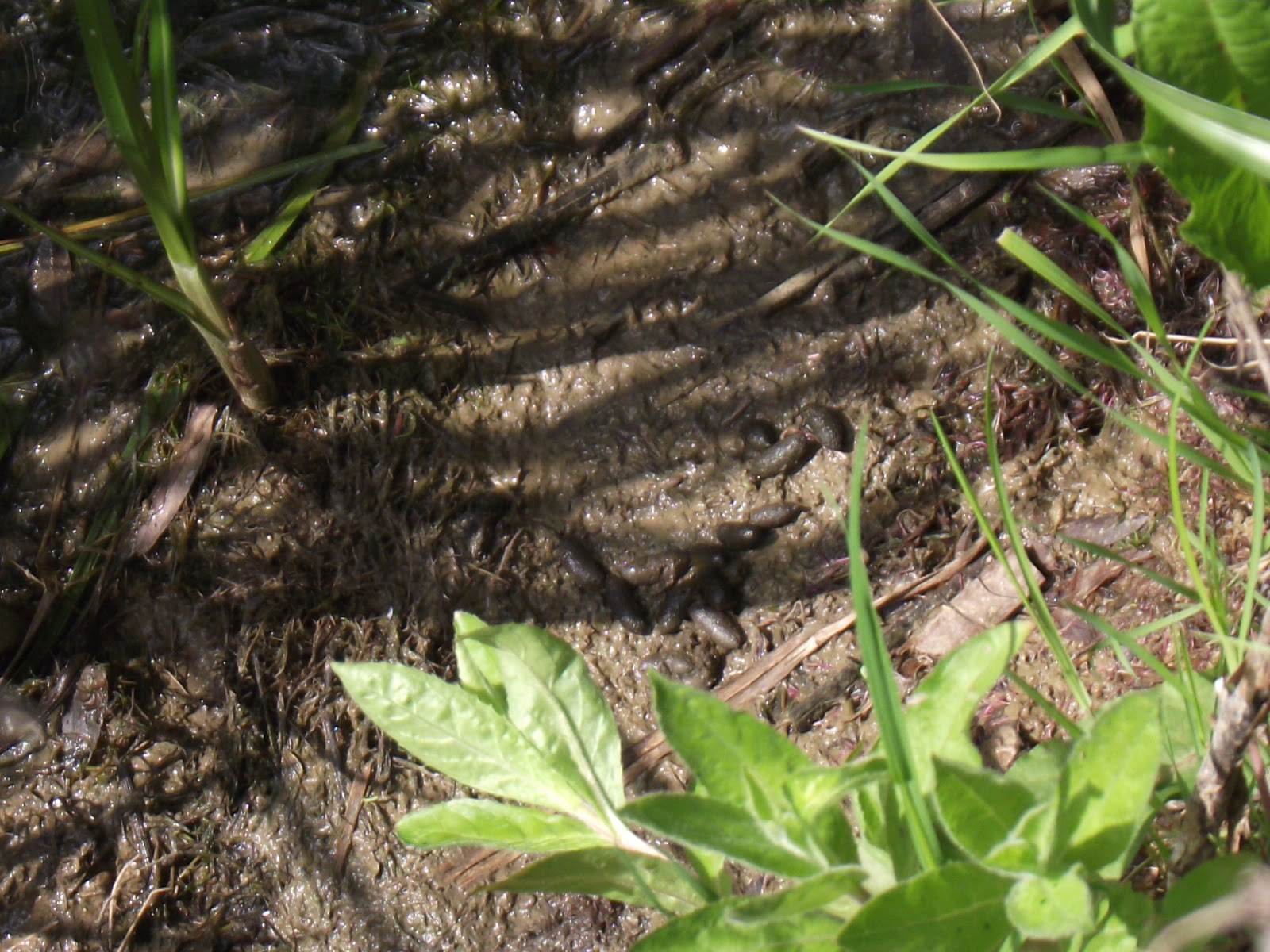
Water Vole poo - like brown tic-tacs!
We found a few field signs of water vole presence around the lake.  Some feeding stations, where the voles chop down the sedges, rushes or grasses that they are feeding on and leave little piles of vegetation.  They are quite distinct in that the edges are cut at 45 degree angles.

We also found a few latrine sites where there were small piles of vole poo which look a lot like brown tic-tacs.  One site we found had a feeding station, a latrine, and just above it there were 3 burrow entrances.  Unfortunately we didn't hear the familiar 'plop' sound of the voles vanishing form our footsteps.

Blue-tailed Damselfly


More vole poo - latrine


Abbotts Hall Farm
  On the way back we to the centre we had a wander round the gardens which were really beautiful.  An excellent course and I hope to use my new-found tracking skills during the summer.
Abbotts Hall Farm - pond

Abbotts Hall Farm - beautiful poppies

Thursday, 19 May 2011

And breathe....

So, my exams finished today and the relief is palpable.... I am already dreaming of walks in the countryside, making full use of my camera, reading novels and the all the other things you can do when you are not totally absorbed in study.  I'm sure I will be desperate to start again by the time we get to August though!

Anyway, I have updated my new Natural History Diary page with some pictures of my recent assignment which saw me scribbling furiously in a notepad and dragging out all my watercolours, pastels and pencils.  Perhaps a little too much time was spent dabbling with the brush and not enough on the writing... 

In all seriousness, it was a fun (albeit immensely time-consuming) exercise which saw me learn a great deal about 30 different species and the management surrounding many of their habitats.

Wednesday, 18 May 2011

Study Tour of the New Forest

Last month a delegation of 12 Writtle College nature afficionados descended upon the New Forest in Hampshire to commence a week-long study tour.  10 students and 2 lecturers intent on discovering all the Forest and surrounding counties had to offer.

We left the college on a beautiful Monday morning in our little minibus of mayhem.  Stopping at the New Forest Wildlife Park we were somewhat disappointed by the lack of animals on show, but Gavin got to see lots of owls, Kara and Michelle made friends with a little deer and there were some very pretty exotic butterflies.  We then stopped off in Lyndhurst for a wander and a some lunch.  The New Forest Visitor Centre provided us with an insight into the history of the area.  Although for others it was a time for dressing-up...

Dressing up time..

Burley YHA


We were staying at Burley YHA which was pretty good and in a nice location.  Very close to lots of heathland and New Forest ponies roaming around.  We spent a fun evening in one of the village pubs and walked home through the golf course/woodland by torchlight back to our bunkbeds.


On Tuesday morning we had a tour of an area of the New Forest by the Forestry Commission which was very informative and it was a beautiful area.  We learnt about the conservation issues in the area and the history of the forest.  We also visited the New Forest Reptile Centre where we were able to see species of native reptiles (inc. adders, lizards, frogs and toads). 

Learning about the conservation of the New Forest
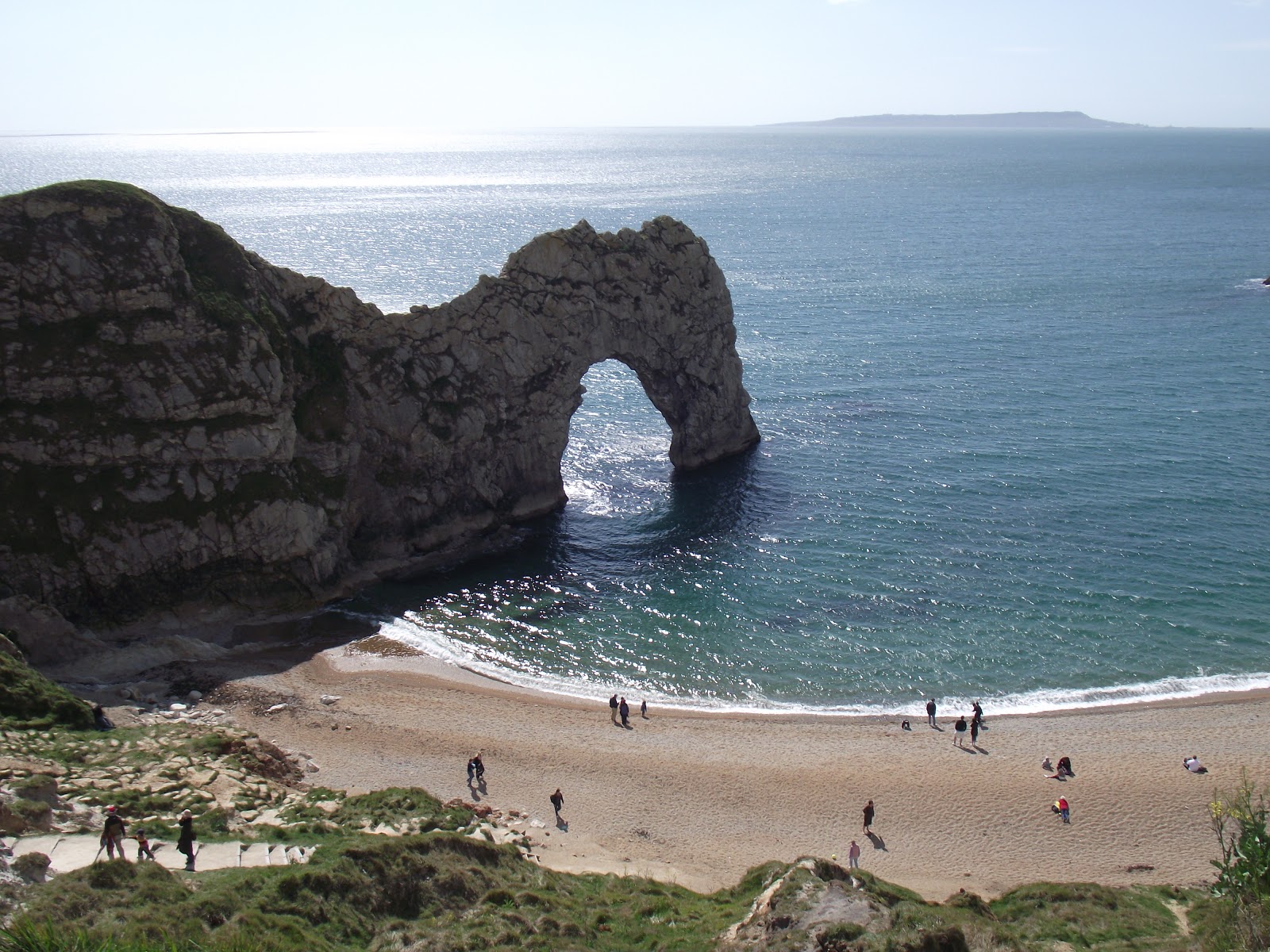
We then drove down to Lulworth Heritage Centre and took a walk round Lulworth Cove and took the beautiful cliff-top path along to Durdle Dor.  This path offers some spectacular views across the Channel but also of the cliffs themselves - a geologist's delight!  I started off dressed in t-shirt, jumper, jacket, hat and scarf but by the time I was half way along the path I was reduced to a t-shirt.  A very steep climb but worth every breath.

The whole group at Durdle Dor


The next day we visited Radipole Lake which is an urban RSPB reserve in the centre of Weymouth.  A very difficult place to manage as it has public footpaths running through it, and offers seclusion to wayward teens looking for a quiet spot to quaff a few cans!!  Lots of birds to be seen and heard including Cetti's Warbler.  We had lunch looking out over Chesil Beach which was beautiful.


On Chesil Beach


Next stop was the internationally important Portland Bill Observatory where we were afforded a tour around the garden to see the mist nets and habitats available to the birds there.  Many birds stop here to refuel or rest on there way up through the UK from their breeding sites in the tropical south.  Whilst we were there we had the priviledge of watching a Willow Warbler being ringed.  We also had a trip up to the top of the observatory to look out across Portland and the sea.  [Only two weeks later Chris Packham (my idol and inspiration) would be stood at the very same point presenting for the
                                          Springwatch Easter Special.]

Bedraggled, but happy!
We returned to the hostel via Maiden Castle, an Iron Age Hill Fort which I had visited before.  By this point it was very wet and windy, but a few hardened souls braved the weather and took a walk around the site.  On the way back to the minibus we were fortunate to see a flock of Linnet, some corn buntings and a couple of stonechat.

The charismatic Fergus
Thursday, and our last full day of activities.  Time passes so quickly on trips like these.  The day was spent a bit further north in Andover and Salisbury.  We visited the Hawk Conservancy Trust first to meet with Fergus, the Great Bustard.  The trust are involved in a conservation project to re-introduce these magnificent birds back to the wild in the UK.  Following our visit here we taken to their release site and home of the Great Bustard Project on Salisbury Plain.  We were able to see a couple of the birds in their release pen, and also a stone curlew.  Unfortunately when we went out onto the plain we didn't spot any.


Our visit here was followed up by an afternoon in the company of the Conservation Officer for the Ministry of Defence.  We learnt about the conflict involved in managing a SSSI site alongside have it used for target practice and military operations. 

Our trip home on Friday was broken up with a visit to Stephen's Castle Heathland in Verwood.  A SSSI this was a very sweet little oasis in the middle of a town.  Lots of botanical interest here including the exquisite sundew.

Botanising at Stephen's Castle
Beautiful sundew
[Drosera rotundifolia]
A thoroughly enjoyable week of learning and getting to know my fellow students that little bit better through ridiculous drinking games and animal impressions....

Tuesday, 5 April 2011

Spring has truly sprung

Last week the weather took a turn for the better and, armed with my camera, I went out looking for willing (or otherwise) subjects for my college natural history diary.  So far the species are mounting up, however pen has not yet reached paper in terms of writing.  Plenty time for that.....


Adder (Vipera berus)

On Friday we took a quick trip out to see if we could find any adders.  Since the weather had warmed up it was hoped that they might be out basking in the sunshine.  Our first forray turned up an adder but it made its escape before some of us could get to it.  The second location we went to was much more successful.  We managed to see about 4 or 5 different adders and a couple of slow worms as well.  I am pretty scared of snakes and walking through the undergrowth looking for them was giving me the creeps.  As long as I could see them I was ok.  I just tried not to think what might be there that I couldn't see.


Slow Worm (Anguis fragilis)


Snake's Head Fritillary (Fritillaria meleagris)
Later that day I was delighted to find a host of beautiful Snake's Head Fritillaries on the college estate.  I remembered these flowers from my trip to La Brenne in France where they are in fact quite rare.  We felled quite a few trees in a woodland area of one of the reserves to allow light to penetrate the canopy and give the Fritillaries a fighting chance.  I hadn't realised that they were quite common in the UK, but was delighted to see them.  Definitely one for the diary!


At the weekend, after I had completed my work party at Langdon Lake & Meadows I took a wander round the reserve to look for butterflies.  I had already seen a Brimstone and a Peacock whilst I had been working but hadn't been able to snap any pictures.  I found a Peacock on the edge of the arable field at the back of the reserve, and also a cute little rabbit (not of any real scientific or diary interest but so cute I have to share the picture!).


Peacock (Inachis io)

Rabbit (Oryctolagus cuniculus)


Finally I walked round the lake and took a couple of pictures of the geese.


Greylag Goose (Anser anser)

Canada Goose (Branta canadensis)


Name that mammal...

I recently took part in Kent Wildlife Trust's Mammal Identification course.  The course took place, unsurprisingly, in Kent at Wildwood Trust.  This is a really lovely place which is a bit like a safari park for native animals.  In actual fact they have a lot of different animals including arctice fox, lynx and bison which are not native, but interesting all the same.

We spent the morning learning about the different families of animals, their main identification features and about fieldcraft techniques, i.e. spotting and identifying tracks and poo.  We were also able to look at pelts, antlers, skulls and other bones in the class to help us get an idea of the size of the animals.

After lunch, outside in the sunshine, we had a tour round the park to see the animals we had been taught about.  Some of which were elusive, weasel and stoat were both quite shy, and the badger had to be coaxed out of bed...

Polecat (Mustela putorius)


Badger (Meles meles)


Otter (Lutra lutra)


Fallow Deer (Dama dama)


Fallow Deer (Dama dama)


Wild Boar (Sus scrofa)


Konik Horse (Equus caballus)

Red Deer (Cervus elaphus)


Red Fox (Vulpes vulpes)

The day was very informative and it was really helpful to see the animals close up to get an indication of their size and key features.  The other animals we saw were:

Arctic Fox (Alopex lagopus); Bison (Bison bonasus); Harvest Mouse (Micromys minutus); Lynx (Lynx lynx); Pine Marten (Martes martes); Stoat (Mustela ermines); Weasel (Mustela nivalis); and Wolf (Canis lupus).

We finished the day off with a "poo i.d. test" in which Kerry and I fared quite admirably.  Chris Packham would have been proud of us!

Wednesday, 9 March 2011

Two Tree Island

In a bid to observe some new species for our natural history diary assignment for college, a small group of us descended upon Two Tree Island at Leigh-on-Sea in Essex.  Two Tree Island is a small tidal island with adjoining salt-marsh and inter-tidal mudflats.  We took a walk initially round the west end of the island spotting Common Redshank (Tringa totanus); Eurasian Teal (Anas crecca); Northern Shoveler (Anas clypeata); Common Ringed Plover (Charadrius hiaticula); and most exciting of all Pied Avocet (Recurvirostra avosetta).  There were about 8 Avocets feeding in the water demonstrating their unique feeding behaviour of sweeping their bill from side to side under water. 

Common Ringed Plover
(Charadrius hiaticula)
Pied Avocet
(Recurvirostra avosetta)

 Further along our journey we spotted a Common Pheasant (Phasianus colchicus); Grey Heron (Ardea cinerea); Brent Goose (Branta bernicla) - these are quite a treat in this area; Common Skylark (Alauda arvensis) singing and fluttering above our heads; and Common Kestrel (Falco tinnunculus) hovering above.

Common Kestrel (Falco tinnunculus)
On the east side of the island we saw Eurasian Oystercatcher (Haematopus ostralegus); Northern Lapwing (Vanellus vanellus) and a Eurasian Curlew (Numenius arquata). 

Heading into the old town of Leigh we spotted several Ruddy Turnstone (Arenaria interpres) along the water's edge feeding.  We also saw a couple of them bobbing about in a boat....


Ruddy Turnstone
(Arenaria interpres)

I thought you were bringing the oars?!


Overall, it was a lovely sunny and warm day, albeit a little hazy across the estuary.  We were able to identify most of what we saw and I think we all came away with something for our diaries.

Thursday, 3 March 2011

Hanningfield Reservoir

Today I took a trip to Hanningfield Reservoir on the way home from college.  I've never been there before but it was quite nice - a mix of woodland birds and wildfowl.

The species list for the hour we were there was:
  • Great Crested Grebe (Podiceps cristatus)
  • Grey Heron (Ardea cinerea)
  • Cormorant (Phalacrocorax carbo)
  • Mallard (Anas pltyrhynchos)
  • Gadwall (Anas strepera)
  • Teal (Anas crecca)
  • Tufted Duck (Aythya faligula)
  • Moorhen (Gallinula chloropus)
  • Coot (Fulica atra)
  • Goldcrest (Regulus regulus)
  • Sisken (Carduelis spinus)
  • Blue Tit (Cyanistes caeruleus)
  • Great Tit (Parus major)
  • Long-Tailed Tit (Aegithalos caudatus)
  • Robin (Erithacus rubecula)
  • Jay (Garrulus glandarius)
  • Magpie (Pica pica)
  • Grey Squirrel (Sciurus carolinensis)


But the star of the show was a little robin.  Whilst sitting on a bench quietly watching the long-tailed tits a little robin had its beady eye on us.  Clearly invading its territory it came ever closer to investigate what we were doing.  It flew at us a few times, and when we finally moved on it landed on the bench to see us off once and for all.  My new camera has done quite a good job of capturing it so I'm very pleased!!