
Sunday, 11 March 2012


Wednesday, 29 February 2012
Nuclear Nature
At the mouth of the River Blackwater at the northern tip of the Dengie Peninsula in Essex lies the defuelled Bradwell Nuclear Power Station. It operated for about 40 years but was decommissioned 10 years ago. Some months ago I pulled a wildlife walk guide from a magazine and stuck it on my shelf thinking 'I'll do that walk sometime'. Well, Sunday was the day. We drove up to Bradwell-on-Sea which is a beautiful little village, with some ridiculously friendly residents, and parked the car in the designated car park near the chapel of St. Peter-on-the-Wall. This restored chapel dates back to 654 (http://www.bradwellchapel.org/) and it is a lovely little place - always open as well so you can go inside for a look around and to get out of the wind off the North Sea!
 |
| St. Peter's-on-the-Wall |
The circular walk takes you right round the sea wall of the peninsula and permits great views of a range of song birds near the bird observatory (run by Essex Birdwatching Society) and the chapel and then waders and wildfowl on the saltmarsh and fields. As we were walking round we saw a huge flock of birds flying in over the sea wall. they just seemed to grow and grow in number and then landed in an arable field to feed and rest. They were Brent Geese and there were thousands of them.
 |
| Brent Geese |
We saw lots of other species of bird but the highlight for me was spotting a common seal just offshore who was looking as us just as intently as we were looking at it. We also saw a couple of hare in the fields on the walk back to the car park.
The species list for the day: Wren; Chaffinch; Skylark; Bombus spp.; Magpie; Reed Bunting; Great Tit; Blue Tit; Greenfinch; Shelduck; Knot; Brent Goose; Oystercatcher; Little Egret; Redshank; Common Seal; Black-headed Gull; Great Spotted Woodpecker; Green Woodpecker; Mallard; House Sparrow; Rook; Wood Pigeon; Carrion Crow; Robin, Blackbird; Rabbit; Fieldfare; Pheasant; Hare and Moorhen.
 |
| Bradwell Power Station |
It was a lovely sunny day and a very long walk. With all the stopping and starting it took us about 4 and a half hours to walk round but I would definitely recommend it. It was great to be by the sea and seeing the sun setting was really beautiful.
 |
| Sunset over the River Blackwater |
Wednesday, 22 February 2012
Busy busy busy...
It's been an incredibly busy month or so and my poor blog has suffered. January saw me take the reigns of the Essex Field Club's "A Wildlife Diary" in their newsletter. First article to appear in April.
I had a wonderful trip down to Dorset with EuCAN again where we (Amy and I) spent a great weekend in Beech Cottage hanging out at the Kingcombe Centre with Nigel, Kathy, Sarah et al. We did some winter twig ID and looed at bryophytes, learnt about traditional hay making in Transylvania, enjoyed a barn dance (with cider and wine), lots of fabulous food and cake, and then spent Sunday morning clearing gorse and hawthorn on a Butterfly Conservation site at Lankham Bottom.
I've been out and about at Langdon again and this weekend we had a work party from Butterfly Conservation join us to continue in our pursuit of the perfect habitat for the Grizzled Skipper. Not sure whether they are going to "move in" but we can hope.
The deadline is looming for the Hanningfield Living Landscape information to be written and submitted for review, so once this current assignment is completed that is next on the list.
Oh, and we had 15cm of snow in Basildon at the start of the month. Great fun!!
 |
| Gloucester Park, Basildon |
 |
| Cormorant drying off |
 |
| Mute Swan |
Wednesday, 11 January 2012
Dissertation topic...
In the next few weeks I really need to decide on a broad topic for my dissertation. I'm due to present some ideas about it to a panel at college sometime in February and then my completed research proposal has to be submitted by the beginning of May, ready to commence the real work from then until Spring 2013....
Slight problem: I haven't got a clue what to choose! So I'm calling for as many suggestions as possible whether it be mammals, birds, butterflies, bats, plants, trees, habitats, landscape ecology.... I just need rough ideas to see what ones might enable me to produce a compelling dissertation!
Answers on a postcard please.... :-)
Monday, 2 January 2012
Happy New Year!
A very happy new year to my handful of readers! Spring seems just around the corner and I can't wait as I got my very first bat detector for Christmas and I want to get out there and use it.
Christmas was spent in Scotland visiting my folks and I was desperate to get out and about, but sadly, the weather was atrocious and I just didn't have the right clothing with me. The journey up the M74 was quite exciting as we saw several buzzards in Dumfries and Galloway which I'd never noticed before - mainly because we normally drive up in the dark! So, a walk around Coombe Wood in Langdon Hills was the order of the day on New Year's Eve once we were back in Essex. It was a really nice walk with views over the Thames Estuary. We saw a few Great Spotted Woodpeckers and some Great Tits, but nothing much else. There were some lovely trees though some great gnarly ones.
So until my next installment... here's to a conservation-tastic 2012!
Saturday, 26 November 2011
Betty, Boar, Beavers, Birds and much, much more
Mid-November sees a break in lectures and this year the college laid on three field trips for those of us who were interested.
Monday was a visit to the Wildwood Trust in Kent to learn more about their captive breeding programmes. In particular their water vole programme. Water vole populations have declined over the years mainly die to loss of habitat and the alien species American Mink. The Trust often takes in voles which are part of a translocation programme. Depending on the length of time they are going to be in captivity they will breed from the animals to ensure their survival. As such it is often the grandchildren of the original animals which are released into the wild. In 2011 they bred approximately 270 voles there. We met "Betty" who was the first water vole I have ever seen in the "fur". We also had a wander round all the cages. It seems to be a very labour intensive process looking after all these voles but a worthwhile project to ensure their survival. The girl pictured with "Betty" is a Writtle graduate currently carrying out an internship with the Trust.
 |
| Introducing "Betty" |
 |
| One of the many enclosures housing the voles |
Following the voles, we were then guided round the rest of the park by a couple of members of the educational team. We were shown some small mammals such as pine marten but then moved on to the boar. it was interesting to see the effect they have on the ground in their enclosure as this would be what it would be like if they were released into the wild. Although they make a mess of the ground with their trampling and snuffling the disturbance can be good for many species. The one species it is not good for is the bluebell. The UK's bluebell woods are the finest examples in the world and boar in the wild could have a catastrophic impact on this.
 |
| "Harriet" the wild boar |
We also saw bison, wolves, lynx, Konik horses and some sleeping beavers. The red squirrels were adorable but they don't seem to do very well in captivity showing signs of stereotypies. This is where the animal behaves in a repetitive or habitual way, such as pacing along the enclosure boundary.
 |
| Konik Horse - another fashionable conservation tool |
 |
| European bison |
 |
| Wildwood Trust |


 |
| One of the red squirrels |
After lunch we drove to a Kent Wildlife Trust site called Ham Fen where they have released beavers into a secured area for conservation purposes. Surrounded by an electric fence the fen is exceptionally boggy, as you would expect, and there were obvious signs of beaver activity with some felled trees and some well-nibbled ones.


Further along the river we encountered exceptionally wet ground and in fact I ended up thigh-deep in a badger burrow. Covered in mud and with walking boots full of water I marched on (carefully) to see the beaver lodge and their dam. An impressive construction built in about a fortnight. They are truly amazing animals in terms of their engineering ability.


On Tuesday we headed out to the Dengie Peninsula (a Special Protection Area and an Area of Outstanding Natural Beauty); a place which inspired films such as War of the Worlds and The Birds due to it's other-worldly, bleak appearance, and somewhere I've wanted to go for some time. We were here to start the Big Birding Bash and we went to a few different sites including arable, coastal and estuarine. Our list of spots (few of which were identified by me!) included:
- Corn Bunting
- Chaffinch
- Goldfinch
- Carrion Crow
- Hooded Crow
- Magpie
- Skylark
- Reed Bunting
- Yellowhammer
- Brent Goose
- Oystercatcher
- Redshank
- Turnstone
- Marsh Harrier
- Little Egret
- Dunlin
- Shelduck
- Curlew
- Golden Plover
- Lapwing
- Mistle Thrush
- Little Owl (the most exciting for me!!)
 |
| Waiting for the owls to show... with some very eerie trees! |
Friday was the last day of the field trip programme and we headed off to Hertfordshire to attend a few talks by staff at Rothamsted Research. Having put a career in research into the melting pot of future ideas I was excited to be going there to find out what it was all about. The place felt very "sciencey" in an old-fashioned kind of way and these people really know what they are talking about. Specialists in aphids, bumblebees and long-term research projects it was fascinating to hear them talk. The focus is very much agricultural research; increasing productivity whilst developing environmentally sustainable solutions.
A trip to the ladies took me back a couple of decades to my Grandma's house when I spotted a little toilet roll doll on top of the hand dryer: fabulous. The staff canteen was pretty fantastic as well. Looks like a good place to work overall!

An excellent week of interesting field trips topped off by having to hand in 3 assignments in quick succession. Perhaps I should have stayed home to concentrate on those - only time will tell! I'm happy to trade a few marks for a sighting of a Little Owl.
Monday, 24 October 2011
What a brain; what a man; what a bird!
Firstly Autumnwatch has returned to our television screens. Now, nothing beats getting out and about in nature except perhaps the delectable and divinely fascinating Chris Packham on your tellybox every Friday evening for a couple of months... or so I thought.
Saturday, 15th October 2011 was a day I never in my wildest dreams imagined would ever occur. Well, obviously the date would occur but what happened on that day was totally fantastic. I still haven't quite recovered. Michelle and I attended the very first Wildlife Xpo at Alexandra Palace in London. We were booked in to listen to three lectures; one of them given by the National Trust's Matthew Oates (butterfly guru and worshipper of HIM - His Imperial Majesty; the Purple Emperor) and the other two by none other than the man of the season Chris Packham.
It was a difficult task keeping my excitement under control. However under control it remained and the photographic evidence is here for all to see. (In case you can't spot me my hair is now short and red!)
 |
| Chris in action |
 |
| Autograph signing |
 |
| With Michelle and the girls from Hanningfield Reserve |
So, there you have it. A day to be remembered. The best thing about it was listening to him talk about so many of the things we are learning at college and to feel really motivated to get out there and do it!
To add to that excitement, this weekend I was idly looking out the patio doors over the garden and paying particular attention to a row of four chubby little sparrows doing a spot of sunbathing when in swooped a whopping great (relatively speaking) sparrowhawk. It landed on the bush on the other side of the fence and turned its head to give me a fantastic view of its yellow eye. Spectacular. And one of Chris' favourite birds I believe. Picture below is from a BBC website as I was nowhere near ready with my camera!
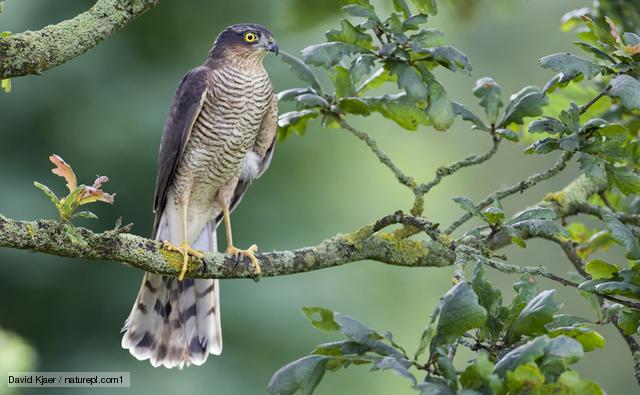 |
| The beautiful sparrowhawk |
Subscribe to:
Posts (Atom)